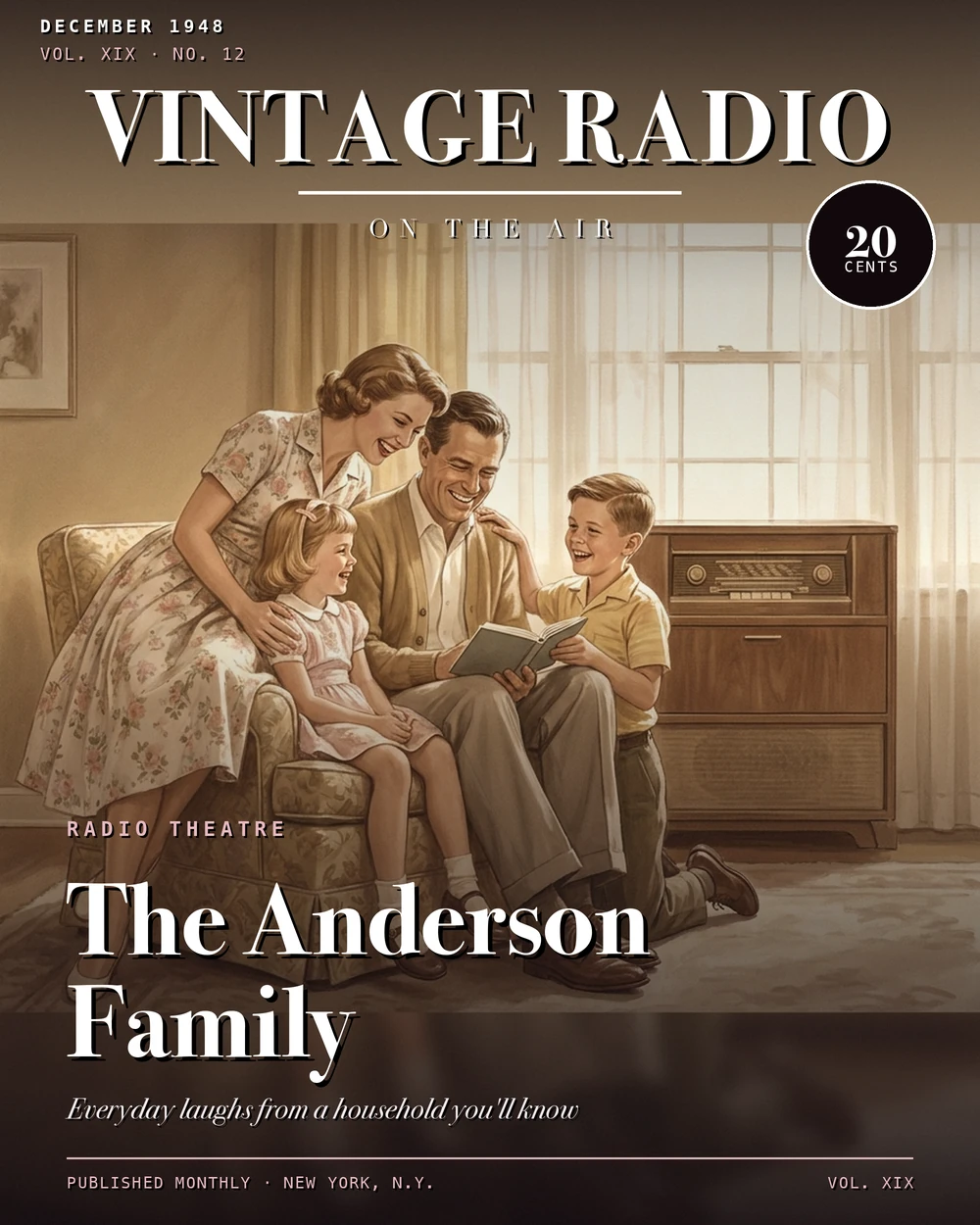
The Anderson Family
A Family Show That Flew Under the Radar
The Anderson Family wasn't a network show with a big sponsor and a prime-time slot. It was a Hollywood Broadcasters production distributed by The Cardinal Company of Hollywood — syndicated, modest, and quietly effective. The first episode was recorded in 1947, and the series produced at least 47 known programs, with episodes surfacing as late as 1951. Each half-hour was pressed onto 16-inch vinyl lateral-cut transcription disks at 33 RPM, cut by union members of IBEW Local 45 in North Hollywood. Those disks made their way to small stations around the country — among them WAYN radio, 900 AM out of Rockingham, North Carolina, where surviving copies still carry handwritten airing dates on the labels.
The premise was simple: Oliver Anderson, his wife Mary, and their son Junior navigate the minor disasters of daily household life. The show's humor came from situation and character rather than big setups — a broken lawn mower, a boat-building project gone sideways, an awkward visit from the father-in-law. These weren't grand comic conceits. They were the frictions of ordinary family life played for laughs, and they worked.
The Cast
Dick Lane — also credited as Richard Lane — played Oliver Anderson, the father at the center of most of the trouble. Louise Arthur played Mary Anderson, and Walter Tetley played Junior, the son who typically announced the week's chaos before the opening organ sting even finished.
Tetley is the name most OTR fans will recognize. Born Walter Campbell Tetzlaff on June 2, 1915, he specialized throughout his career in playing young characters, a result of a purported glandular disorder that prevented his voice from ever maturing. He brought the same quality to his long-running role as nephew Leroy on The Great Gildersleeve, which he joined in 1941, and to his part as delivery boy Julius Abbruzio on The Phil Harris–Alice Faye Show. On The Anderson Family, that perpetually young voice was the signature sound — Junior's opening proclamation of whatever trouble the episode held set the tone before a single scene played out.
The show was written by Howard Swartz (sometimes spelled Schwartz in certain sources) and directed by Herb Litton (also listed as Herb Lytton). Hollywood Broadcasters, the production company behind the series, also produced Adventures By Morse, The Johnson Family, and Barnyard Jamboree, giving some sense of the syndicated programming landscape the show inhabited.
What Survives
Programs 1 through 47 are known to have been made, though not all have turned up. Thirty-six episodes were transferred in Natanic, Massachusetts in 2003, representing the largest known surviving transfer. Five episode titles are confirmed in the broadcast catalog: Lawn Mower, Building a Boat, Father-in-Law's Visit, The Radio Station, and Tight Cowboy Boots. A maintained set of the series was released in February 2021.
OTR enthusiasts most often compare the show to Father Knows Best, and a fair number of listeners who know both consider the lesser-known syndicated program to be the funnier of the two. It's a reasonable argument. The Anderson family's situations felt lived-in rather than constructed, and the comic rhythm that Tetley and the rest of the cast settled into had an ease that network polish sometimes crowds out. The show shared the airwaves with bigger names — Abbott and Costello, Amos & Andy — but it operated in a different register, closer to the ground.